Skip to content
-
(a) Condemns the ‘Mammonist Philosophy’ of “Work very hard and enjoy sense gratification”
(b) The cycle of performing yajna is an absolute necessity
- Yajna is important for happiness in this world
- Also, it helps one in spiritual elevation which is the purpose of human life.
- Yajna process gradually purifies to bring one to the platform of Krishna consciousness – Therefore indirectly it is the practice of Krishna consciousness
o If by performing yajnas, one does not become Krishna conscious, such principles are counted as moral codes
o One should not therefore limit his progress only to the point of moral codes, but should transcend them, to attain Krishna consciousness.
(c) Nature’s law for human life – Human life is specifically meant for self-realisation in either of the three ways: karma-yoga, jnana-yoga or bhakti-yoga
- Exception – No necessity to rigidly follow the prescribed yajnas for those transcendentalist who are above vice and virtue.
- But those engaged in sense gratification require purification by performance of yajna.
(a) “Yajnartha-Karma” – It implies “Necessity to work for satisfaction of Krishna only” (yuktavairagya). This is more expressly stately here:
- If we have to work for the satisfaction of the Yajna-purusha, ‘Vishnu’, then we must find out the direction of work in Brahman, or the transcendental Vedas.
(b) The need of Vedas:
- Vedas – They are the codes of working direction
- Analogy: Just like one has to work in ordinary life by the direction of the state, one similarly
has to work under the direction of the Supreme state of the Lord
- Avoiding the Vedas – Any unauthorized or sinful work, without Vedic direction is called Vikarma
(c) Omnipotency of the Lord – This implies He can perform through each of His senses, the action of all other senses. 3 examples:
- Speak by breathing air – Vedas emanations from breathing of Lord
- Impregnates material nature by His glance
- Eat by seeing or hearing the words of devotion
(d) Plan for the living entity
- All conditioned souls are eager for material enjoyment.
- Vedic directions are designed in a way one can satisfy one’s perverted desires and then return to Godhead, having finished his so-called enjoyment
- Material creation offers conditioned souls to learn the science of yajna and attain liberation
- Importance of Krishna consciousness – Even those who have not followed the Vedic injunctions may adopt the principles of Krishna Consciousness and that will take the place of performance of Vedic yajnas or karmas.
-
(a) “Yajnartha-Karma” – It implies “Necessity to work for satisfaction of Krishna only” (yuktavairagya). This is more expressly stately here:
- If we have to work for the satisfaction of the Yajna-purusha, ‘Vishnu’, then we must find out the direction of work in Brahman, or the transcendental Vedas.
(b) The need of Vedas:
- Vedas – They are the codes of working direction
- Analogy: Just like one has to work in ordinary life by the direction of the state, one similarly
has to work under the direction of the Supreme state of the Lord
- Avoiding the Vedas – Any unauthorized or sinful work, without Vedic direction is called Vikarma
(c) Omnipotency of the Lord – This implies He can perform through each of His senses, the action of all other senses. 3 examples:
- Speak by breathing air – Vedas emanations from breathing of Lord
- Impregnates material nature by His glance
- Eat by seeing or hearing the words of devotion
(d) Plan for the living entity
- All conditioned souls are eager for material enjoyment.
- Vedic directions are designed in a way one can satisfy one’s perverted desires and then return to Godhead, having finished his so-called enjoyment
- Material creation offers conditioned souls to learn the science of yajna and attain liberation
- Importance of Krishna consciousness – Even those who have not followed the Vedic injunctions may adopt the principles of Krishna Consciousness and that will take the place of performance of Vedic yajnas or karmas.
(a) Why there is no need to worship demigods. Because:
- Demigods are only the appointed officers for material management
- Vedas give sacrifices to satisfy these demigods to achieve all material supplies
- Satisfying Krishna satisfies all the demigods who are like different limbs of the body; therefore no separate need to worship the demigod
(b) Analogy of Krishna consciousness and antiseptic immunity: Prasadam gives immunity from all material reactions, e.g. Antiseptic vaccine during epidemic
- Conclusion – Krishna conscious sacrifice provides freedom from all past sins and immunizes against future reactions.
(c) Dangers of not accepting offered food –
- Such a person continues to increase the volume of sinful action
- Thus prepares the next body to resemble hogs and dogs to suffer the resultant actions
(d) Role of Sankirtana-yajna even for supply of food and protection from scarcity
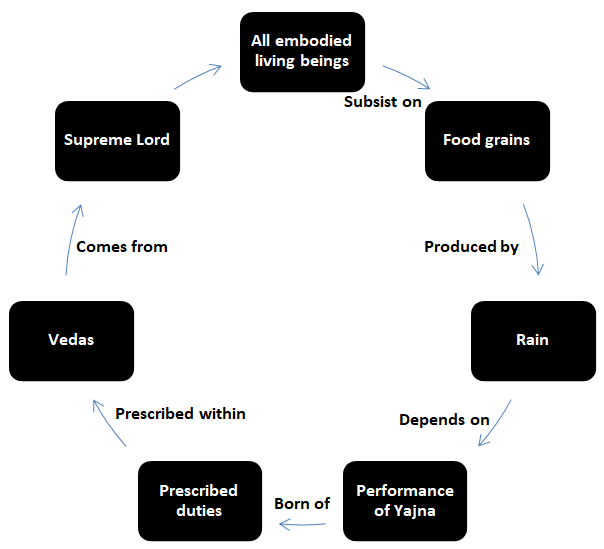
- For all eatables we have to depend upon the production of fields which depends on rains
- Rains are controlled by demigods who are servants of the Lord
- And the Lord can be satisfied only by sacrifices
- Sacrifice for this age – Sankirtana-yajna
-
(a) Why there is no need to worship demigods. Because:
- Demigods are only the appointed officers for material management
- Vedas give sacrifices to satisfy these demigods to achieve all material supplies
- Satisfying Krishna satisfies all the demigods who are like different limbs of the body; therefore no separate need to worship the demigod
(b) Analogy of Krishna consciousness and antiseptic immunity: Prasadam gives immunity from all material reactions, e.g. Antiseptic vaccine during epidemic
- Conclusion – Krishna conscious sacrifice provides freedom from all past sins and immunizes against future reactions.
(c) Dangers of not accepting offered food –
- Such a person continues to increase the volume of sinful action
- Thus prepares the next body to resemble hogs and dogs to suffer the resultant actions
(d) Role of Sankirtana-yajna even for supply of food and protection from scarcity
- For all eatables we have to depend upon the production of fields which depends on rains
- Rains are controlled by demigods who are servants of the Lord
- And the Lord can be satisfied only by sacrifices
- Sacrifice for this age – Sankirtana-yajna
(a) Definition of ‘Santas’ – Devotees who are always in love with lord
- Ref. Brahma Samhita 5.38 – “Premanjana…”
(b) Different yajnas performed by devotees – different varieties of devotional service as sravanam, kirtanam etc.
(c) Benefit – Freedom from “sinful reaction”
(d) “Sankirtana-yajna” : “Easy process to happiness and peace” for all people because without yajna, one is thief and sinful, and thus no happiness
(e) How devotees are freed from sinful reactions – because they eat food first offered in sacrifice.
(f) Fate of those who prepare food for their own self – They are thieves and sinful – Thus there is no happiness.
-
(a) Definition of ‘Santas’ – Devotees who are always in love with lord
- Ref. Brahma Samhita 5.38 – “Premanjana…”
(b) Different yajnas performed by devotees – different varieties of devotional service as sravanam, kirtanam etc.
(c) Benefit – Freedom from “sinful reaction”
(d) “Sankirtana-yajna” : “Easy process to happiness and peace” for all people because without yajna, one is thief and sinful, and thus no happiness
(e) How devotees are freed from sinful reactions – because they eat food first offered in sacrifice.
(f) Fate of those who prepare food for their own self – They are thieves and sinful – Thus there is no happiness.
(a) “Who are demigods (3 different definitions)
- Empowered administrators of material affairs
- Innumerable assistants in different parts of the body of Supreme Personality of Godhead
- Authorized supplying agents on behalf of the Supreme Personality of Godhead
(b) Function of the demigods (3.11)
- Supply all the benedictions necessary to keep body & soul together
- Their pleasure and displeasure depend on the performance of yajna
(c) Chief purpose of all yajnas – Ultimate satisfaction of Yajna-pati “Vishnu” (3.11) – Ref. Bg. 5.29 “bhoktaram…”
(d) Benefits of “yajna” (3.11)
- No scarcity of the supply of natural products – thus happiness in this world is guaranteed
- Side Benefits: Gradual purification to help ultimate liberation – this happens in the following steps:
When eatables are sanctified by yajna Existence is Purified → Finer tissues in memory are sanctified → Thus one can think of path of liberation → All these combined lead to Krishna Consciousness, the great necessity of present day society.
(e) For whom, sacrifice to demigods is recommended, if ultimate beneficiary is supposed to be Vishnu.
- This is for one who cannot understand the Supreme Personality of Godhead
(f) Basis of different yajnas – They are recommended based on different modes of different person. Ultimate Goal of all yajnas is gradual promotion to transcendental position
(g) All material necessities come through yajna e.g.
- All eatables, either vegetarian or non-vegetarian (because all animals subsist on vegetation)
- Heat, light, water, air etc.
- All manufacturing enterprises
(h) Purpose of all these material supplies
- To keep body and soul together for the self–realization
(i) “Dangers” of not performing yajnas
- One is called a ‘thief’ – Because one forgets the purpose of creation and takes all the supplies for sense gratification and thus enjoys the gifts without offering to the demigods in return (3.12)
- Society of thieves can “never be happy” because they have no aim in life (3.12)
- “Gets sinful reaction” (3.13)
(j) Easiest yajna for this age – Sankirtana-yajna inaugurated by Lord Caitanya.
-
(a) “Who are demigods (3 different definitions)
- Empowered administrators of material affairs
- Innumerable assistants in different parts of the body of Supreme Personality of Godhead
- Authorized supplying agents on behalf of the Supreme Personality of Godhead
(b) Function of the demigods (3.11)
- Supply all the benedictions necessary to keep body & soul together
- Their pleasure and displeasure depend on the performance of yajna
(c) Chief purpose of all yajnas – Ultimate satisfaction of Yajna-pati “Vishnu” (3.11) – Ref. Bg. 5.29 “bhoktaram…”
(d) Benefits of “yajna” (3.11)
- No scarcity of the supply of natural products – thus happiness in this world is guaranteed
- Side Benefits: Gradual purification to help ultimate liberation – this happens in the following steps:
When eatables are sanctified by yajna Existence is Purified → Finer tissues in memory are sanctified → Thus one can think of path of liberation → All these combined lead to Krishna Consciousness, the great necessity of present day society.
(e) For whom, sacrifice to demigods is recommended, if ultimate beneficiary is supposed to be Vishnu.
- This is for one who cannot understand the Supreme Personality of Godhead
(f) Basis of different yajnas – They are recommended based on different modes of different person. Ultimate Goal of all yajnas is gradual promotion to transcendental position
(g) All material necessities come through yajna e.g.
- All eatables, either vegetarian or non-vegetarian (because all animals subsist on vegetation)
- Heat, light, water, air etc.
- All manufacturing enterprises
(h) Purpose of all these material supplies
- To keep body and soul together for the self–realization
(i) “Dangers” of not performing yajnas
- One is called a ‘thief’ – Because one forgets the purpose of creation and takes all the supplies for sense gratification and thus enjoys the gifts without offering to the demigods in return (3.12)
- Society of thieves can “never be happy” because they have no aim in life (3.12)
- “Gets sinful reaction” (3.13)
(j) Easiest yajna for this age – Sankirtana-yajna inaugurated by Lord Caitanya.
(a) Purpose of material creation
- A chance offered to conditioned souls to come Back to Godhead
- To “Learn how to perform yajnas” for satisfaction of Supreme
(b) Benefit of yajnas:
- To get happiness in material world and
- To purify the heart of the living entity
- Later enter into kingdom of God and thus get ultimate liberation
(c) Cause of conditioning in material world – Forgetfulness of our relationship with Krishna
(d) Purpose of Vedic Principles: To help us in understanding this eternal relationship
(e) Understanding of the Lord as “Pati” (Only master for all the living entities)
- Ref. Vedic hymns – “Patim visvasyatmesvaram…”
- Ref. SB 2.4.20 – Vishnu is the only ‘pati’ or ‘Lord of all living entities’
(f) Best yajna to satisfy Vishnu in the Age of kali – “Sankirtan-yajna”B – which is easy and sublime
- Introduced by Lord Caitanya (Ref. SB 11.5.32: “krsna-varnam…”)
- Ref Bg. 9.14: “satatam kirtayanto…” – Mahatmas constantly glorify the Lord
-
(a) Purpose of material creation
- A chance offered to conditioned souls to come Back to Godhead
- To “Learn how to perform yajnas” for satisfaction of Supreme
(b) Benefit of yajnas:
- To get happiness in material world and
- To purify the heart of the living entity
- Later enter into kingdom of God and thus get ultimate liberation
(c) Cause of conditioning in material world – Forgetfulness of our relationship with Krishna
(d) Purpose of Vedic Principles: To help us in understanding this eternal relationship
(e) Understanding of the Lord as “Pati” (Only master for all the living entities)
- Ref. Vedic hymns – “Patim visvasyatmesvaram…”
- Ref. SB 2.4.20 – Vishnu is the only ‘pati’ or ‘Lord of all living entities’
(f) Best yajna to satisfy Vishnu in the Age of kali – “Sankirtan-yajna”B – which is easy and sublime
- Introduced by Lord Caitanya (Ref. SB 11.5.32: “krsna-varnam…”)
- Ref Bg. 9.14: “satatam kirtayanto…” – Mahatmas constantly glorify the Lord